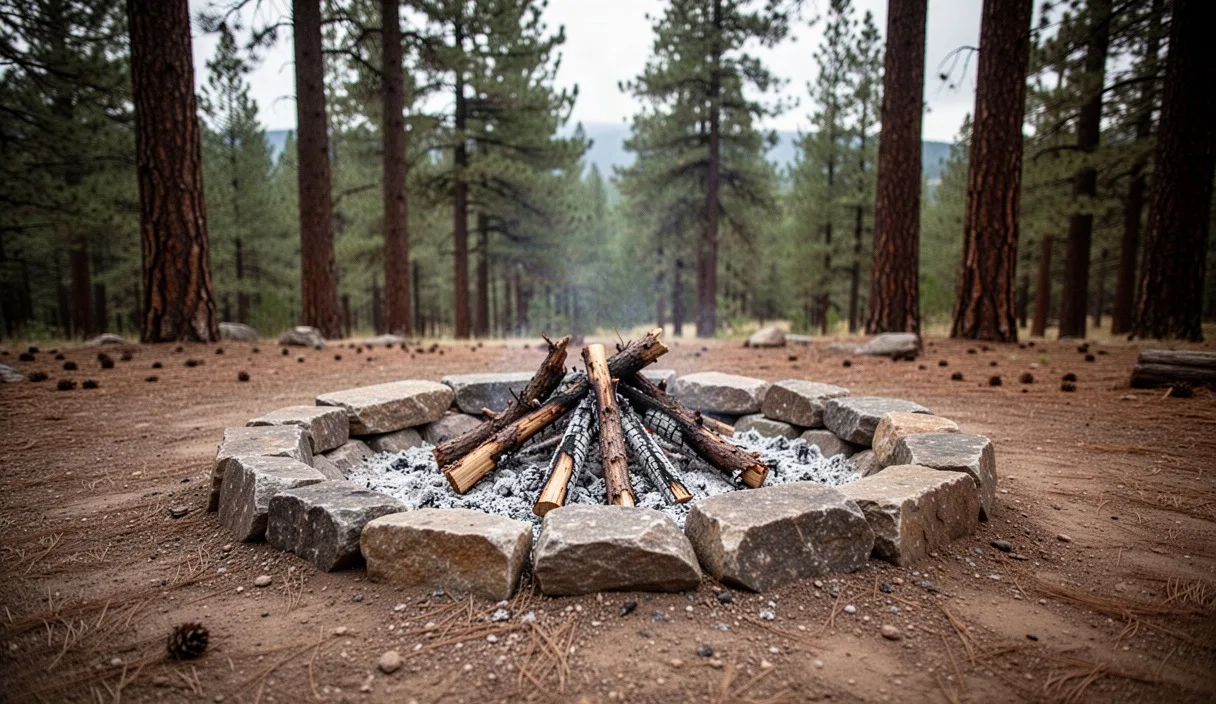
High winds destroy loose tarps. When gusts exceed 25 knots, fabric flutter places shock loads of 80 to 140 pounds onto your cordage and anchor points. Using the wrong hitch leads to two outcomes: the knot slips and drops the shelter on your face, or the fibers bind so tightly under load that you must cut your line with a knife at dawn. Reliable camp craft relies on friction hitches that hold firm under cycling tension yet release instantly when you pull a tail.
Every setup requires a balanced system of static anchors, tensioning loops, and adjustable guy points. Nylon cords stretch up to eight percent under tension, while polyester and ultra-high-molecular-weight polyethylene lines stretch less than two percent. The knots below accommodate these material variations, keeping a flat pitch across heavy rain and blustery conditions.
Anchoring ridgelines with the Siberian hitch
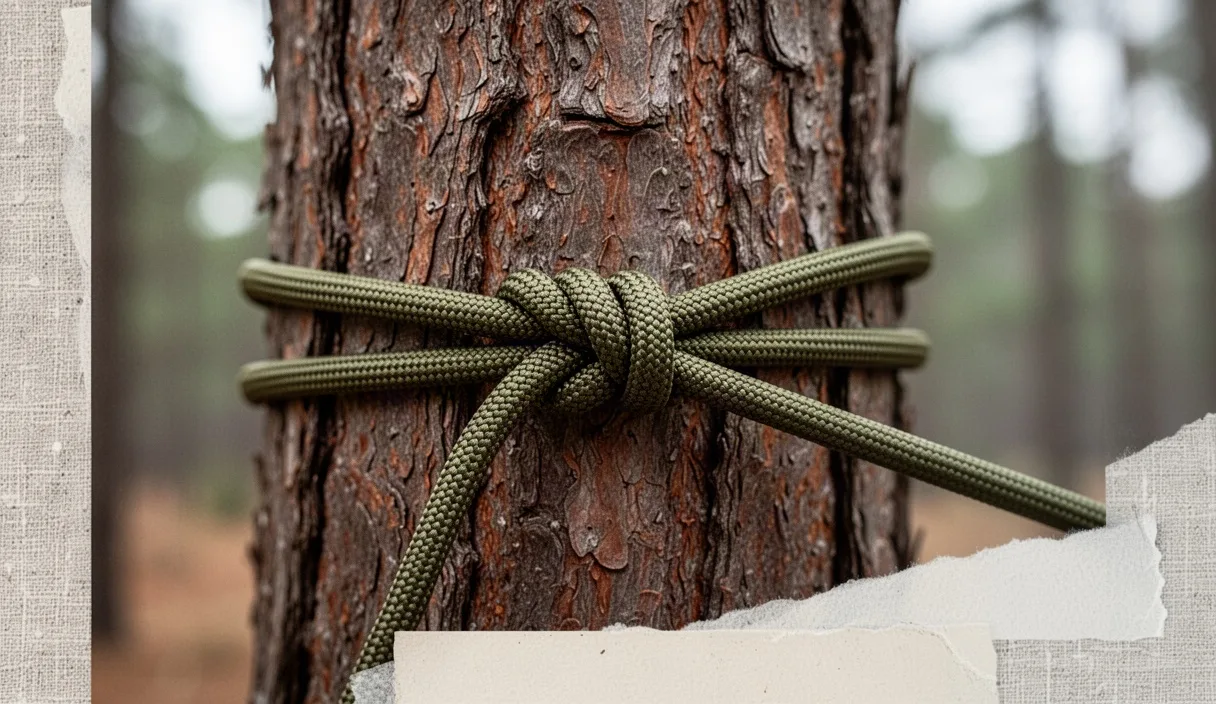
The Siberian hitch, also known as the Evenk hitch, fixes the primary end of your ridgeline to an anchor tree. Cold fingers inside heavy gloves can tie and untie this knot in less than ten seconds. It relies on an indirect wrap around the trunk followed by a slipped figure-eight lock that holds against continuous sideways drag.
Run your cord around the tree at chest height, roughly five feet from the ground. Wrap the working end around your fingers to build the initial crossover, trap a bight of the running line through the eye, and pull the standing line tight. The knot seats itself firmly against rough bark, using the tree's circumference to absorb the bulk of the wind's initial shear force.
Tying the Siberian hitch
- Pass the working end behind the tree from right to left, keeping the standing line taut in your left hand.
- Drape the working end over your open right palm, loop it around your four fingers, and bring it underneath the standing part.
- Rotate your right hand inward to form a twist in the loop wrapped around your fingers.
- Grasp a bight of the working end with your fingertips and draw it back through the twisted loop.
- Hold the tucked bight firmly while pulling the standing line toward the opposite anchor tree to seat the knot against the trunk.
To strike camp, pull the free tag end. The slipped loop collapses instantly, freeing the line without picking at jammed cord fibers. In freezing rain, this prevents ice build-up from locking your primary anchor to the tree bark.
Creating high tension with the trucker's hitch
A saggy ridgeline catches wind like a sail, driving rain beneath the edges. The trucker's hitch acts as a pulley system, multiplying your pulling force by roughly three to one, minus the natural friction of the rope rubbing against itself. This allows you to remove all belly from an eight-foot or twelve-foot suspension line.
Do not use a standard directional figure-eight to form the intermediate loop if you expect sustained gusts. Heavy wind cycles will bind an inline loop under 4mm cordage. Instead, tie a slip knot on the bight that untwists when the tension releases, or use a bellringer's hitch to ensure jam-free operation.
| Loop Style | Mechanical Advantage | Jam Resistance in 35 mph Gusts | Untying Difficulty When Soaked |
|---|---|---|---|
| Slip knot on bight | 3 to 1 nominal | Moderate to high | Low (pulls out instantly) |
| Directional figure-eight | 3 to 1 nominal | Low (welds easily) | High (requires a marlinspike) |
| Butterfly loop | 3 to 1 nominal | High | Moderate (needs wriggling) |
Applying the mechanical advantage
- Walk the working line around the second anchor tree and sight down the ridgeline to estimate the center point.
- Form a slip knot loop in the standing line about three feet out from the tree trunk, facing the loop toward the anchor.
- Pass the running end around the anchor tree and feed it up through the slip loop.
- Pull the running line back toward the tree. The 3-to-1 purchase pulls the line drum-tight.
- Secure the tension by throwing two half-hitches around the doubled lines immediately below the pulley loop. Finish with a slipped final turn for a rapid strike.
Adjusting guyouts using the taut-line hitch
Ground guyouts take the brunt of corner deflection when wind hits broadside. Guyout ropes need constant micro-adjustments as stakes settle in loose soil or nylon tarps stretch overnight. The taut-line hitch gives you an adjustable friction sleeve that grips the standing line under load but slides freely when you push the coil by hand.
This knot requires three total wraps inside the friction zone to prevent slippage on slick braided cordage. When rigging for high winds, tie the hitch on the tarp end or down at the stake, keeping the adjustment zone within easy reach from your shelter door so you do not have to venture out in a downpour.
Tying a secure taut-line
- Run the cord through the corner tie-out loop or around a ground stake driven at a 45-degree angle.
- Bring the working end back parallel to the standing part, leaving an eighteen-inch tail to work with.
- Wrap the working end inside the loop around the standing line, moving toward the anchor stake.
- Make a second wrap inside the loop, laying the turn tightly next to the first wrap without crossing it.
- Carry the working end outside the loop, moving away from the anchor stake, and finish with a single half-hitch around the standing line.
- Cinch the wraps together with your thumb and forefinger until the coils bite uniformly into the core line.
If you use low-friction cords like Dyneema or reflective UHMWPE, the standard taut-line will slide under thirty pounds of load. Swap the third step for a Midshipman's hitch, which places the second wrap over the first wrap to create an internal jam that bites harder into slippery sheaths.
Securing ground grommets via the round turn
Grommets tear out of fabric when shock loads focus on a single metal rim. The round turn with two half-hitches solves this problem by spreading friction across two full contact surfaces before the knot even engages. It is one of the oldest, most reliable anchor closures in naval rigging.
Use this hitch to secure corner tie-outs directly to heavy root systems, split logs, or rock anchors when the soil is too rocky for standard stakes. By taking a full turn and a half around the object, the rope absorbs over seventy percent of the total pull weight strictly through surface friction against the timber or rock.
Securing a high-load anchor point
- Pass the cord through the tarp web loop or grommet, then around the ground anchor (log, root, or heavy stone).
- Take the cord around the anchor a second time so you have a complete circle (the round turn). Both lines should lay parallel without crossing.
- Bring the working end over and under the standing line to make an initial half-hitch.
- Continue in the same direction around the standing line to tie a second half-hitch, forming a clove hitch on the line.
- Snug the half-hitches against the round turn to prevent mechanical vibration from shaking the tag end loose.
In high wind, always tie your guyline into the webbing loops rather than raw brass grommets if your tarp includes both. Webbing loops distribute the wind load along the reinforced edge seams, whereas grommets exert point pressure that will rip through silnylon or polyurethane coatings during sustained forty-mile-per-hour gusts.
Preventing cord binding in wet nylon fibers
Water changes cord behavior. When rain saturates braided paracord or accessory line, the synthetic outer sheath swells while the core shrinks. Under the sustained tension of wind-whipped tarps, tight turns compress the wet filaments together. The friction turns into a mechanical lock, creating knots that seem permanently welded shut.
You can prevent bound knots entirely by modifying how you finish your hitches. Using bights instead of raw ends makes every knot quick-release. Inserting a wooden toggle into the critical pressure point of a hitch creates a spacer that breaks the friction lock instantly when removed.
Toggle-locking and toggle-breaking tactics
- Insert a smooth hardwood stick: Slip a dried finger-sized stick into the bight of your tensioning hitch before you pull the final wraps tight. When breaking camp, push the toggle out; the knot loses its tension core and falls apart freely.
- Double-turn slipped bights: Always finish terminal hitches with a folded bight of line rather than pulling the bitter end all the way through the final loop.
- Select polyester over nylon: Polyester maintains near-identical dry and wet knot friction profiles. It absorbs less than one percent of its weight in water, eliminating the fiber expansion that causes jammed hitches.
- Carry a rounded bone or hardwood marlinspike: Never use the tip of a pocket knife to pry open a wet knot. A single slip will sever load-bearing strands. Use a smooth marlinspike to work between the coils and leverage the wraps open.
Common mistakes
Campers often cut corners when pitching shelters in fair weather, leaving them vulnerable when midnight wind fronts arrive. Avoid these frequent rigging failures:
- Using square knots to join ridgelines: A square knot (reef knot) capsizes under dynamic loads. It will spill and pull through when subjected to uneven wind buffeting. Use a sheet bend or double fisherman's knot to join two lengths of cordage.
- Pulling guylines at flat angles: Running a guyline almost flat along the ground increases the mechanical pull on the stake, pulling it out like a lever. Keep your guyline angle near 45 degrees relative to the ground to drive the force downward into the soil.
- Leaving slack before nightfall: Even slight slack allows the tarp to gain momentum during a gust, turning a constant twenty-pound drag into an eighty-pound hammer strike against your knots. Retension all lines thirty minutes after the initial pitch.
- Relying on bare paracord inner strands: Stripping the core out of 550 cord to save weight leaves a flat nylon tube that stretches excessively and welds permanently under tension. Keep the core strands intact for structural anchor lines.
Practical next steps
Do not practice these hitches for the first time while fighting a rainstorm at dusk. Muscle memory is what keeps your camp standing when your hands are cold and daylight is gone.
Cut two twenty-foot hanks of 3mm or 4mm braided utility line. Step into your backyard or a local park with two trees spaced twelve to fifteen feet apart. Tie the Siberian hitch on the first tree, walk across, rig the trucker's hitch on the second, and tension the line until it hums when plucked like a bass string. Release both knots using only their quick-release bights, time yourself, and repeat until the motions require no active thought. For formal safety rigging standards, fall-protection lines, or commercial shelter engineering, always consult a certified arborist or professional rigger.